
Your service page is your best salesperson. Stop treating it like a brochure.
Most B2B service pages do not sell. Not because the service is bad, but because the page is written for the business owner, not the customer. It describes what you do, lists features, repeats the word “professional” four times… and never answers the only question the reader has: “does this solve my problem, and can I trust you?”
A good service page does two things at once: it speaks to Google (and AI) so people can find you, and it speaks to a person with a specific problem so they choose you. The two do not compete. They reinforce each other. In this guide I will show you how to write and structure pages that do both, with B2B examples you can copy today.
+32%
bounce rate if load time goes from 1 to 3 s (Google)
17%
of B2B buying time is spent talking to suppliers (Gartner)
<15 s
is how long you have to convince (or lose) a visitor (Nielsen Norman Group)
Read them together and you will see the challenge: B2B buyers research almost entirely on their own, decide in seconds and leave if the site is slow. Your page has to load fast, hook them on the first screen and close without anyone from the sales team in the room. If speed is your bottleneck, start here: how to improve your website speed and increase conversions.
What a service page that converts looks like
A service page that converts is a page dedicated to a single service, optimised for a specific search intent, that guides the reader from their problem to a clear action (book, get in touch, request a quote). It is not a catalogue or an “about us” page: it is a sales tool focused on a single goal.
The key is “one service, one page, one intent”. If you sell SEO audits, UX consulting and web design, that is three pages, not a list under one heading. Each one ranks for its own keywords and converts a different type of customer.
Why they are your most profitable SEO asset in B2B
In B2B the buying cycle is long and the decision is made by several people. Your service page is what the buying committee reads alone, at eleven at night, comparing you with two competitors. It is also what AI engines cite when someone asks ChatGPT “who does X in Barcelona?”. If that page is clear, structured and demonstrates authority, it works in your favour on both fronts.
- They capture high-intent traffic: someone searching for “SEO consulting for SaaS” is much closer to buying than someone reading a blog post.
- They convert without intermediaries: they work 24/7, even when your team is asleep or in another meeting.
- They are measurable: one page = one goal = one conversion rate you can optimise month after month.
The anatomy of a service page that ranks and converts
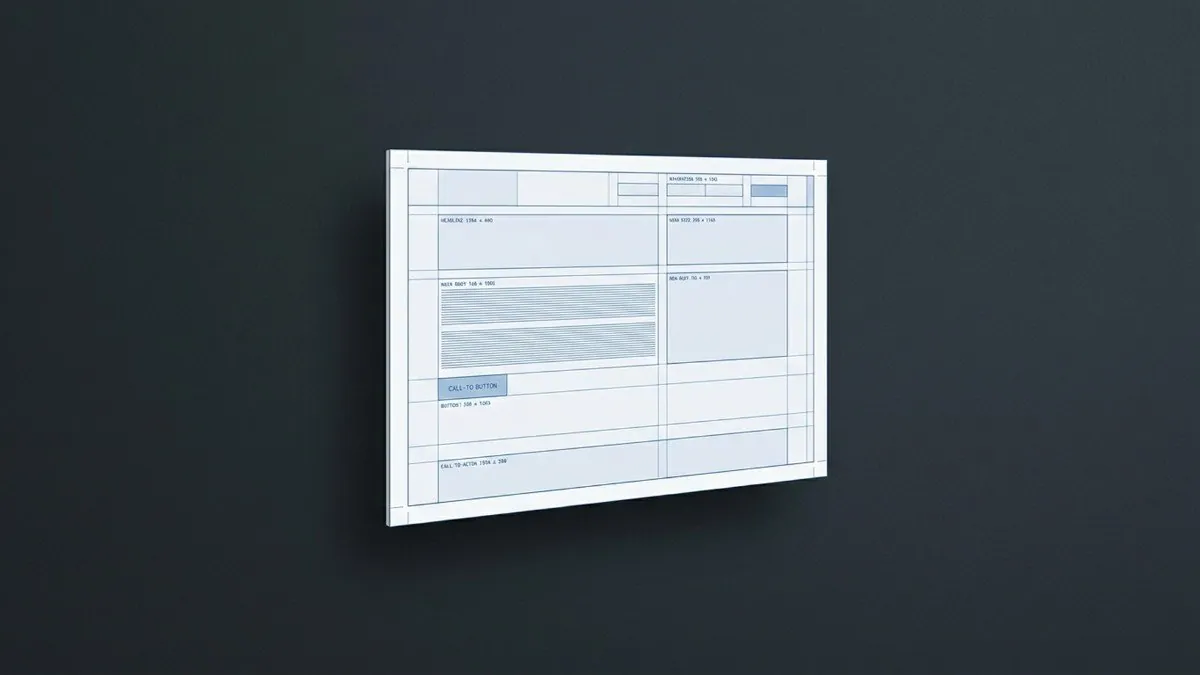
This is the structure we use at Deseo Lab and the one I recommend to B2B clients. Seven blocks, in this order. It is not a rigid template, but the order matters: it respects how a buyer’s mind makes decisions.
- Headline and promise (what is visible without scrolling) A clear H1 with the keyword, a one-sentence outcome promise and a visible button. No empty slogans. Example: “SEO consulting for B2B SaaS: more qualified leads in 3-6 months”. Visitors should understand within 5 seconds what you offer, who it is for and what they gain.
- The customer’s problem (before talking about yourself) Start with their pain, not your story. “Your website gets visits but no meetings?” connects better than “We are an agency with 10 years of experience”. When someone feels understood, they keep reading.
- How you solve it (the service, in benefits) Explain what the service includes by translating each feature into a benefit. Not “40-point technical audit” but “we identify what is holding back your rankings and give you a plan prioritised by impact”. The feature provides credibility; the benefit sells.
- Proof (what makes you credible) Testimonials with name and job title, client logos, case studies with figures, certifications. In B2B, social proof is decisive: it reduces the perceived risk for the person who will recommend you internally. One real case with a concrete number is worth more than three paragraphs of self-praise.
- Process (what working with you will be like) Three to five steps that remove uncertainty: initial analysis, proposal, execution, measurement. In high-value services, the client is not just buying the result: they are buying peace of mind about the journey. Showing it reduces friction.
- Objections and FAQs Answer in advance whatever is holding back the decision: price, timelines, commitment, how you are different. A well-built FAQ block resolves doubts and is also gold for SEO and for AI to extract direct answers from your page.
- Call to action (one, clear, repeated) A single goal per page. Repeat the CTA at the beginning, in the middle and at the end, always with the same action verb: “Book your free audit”. Do not mix “download the guide”, “call us” and “subscribe”: every extra option dilutes conversion.
The layout of these seven blocks is not decorative: it is what holds up conversion. Visual hierarchy, white space, buttons that stand out and forms that do not scare people off. That is where conversion-focused UX/UI design makes the difference between a page that gets read and one that sells.
How to write the copy (the part almost everyone gets wrong)
Speak in your customer’s voice, not yours
The best sentences on your website are not written by you: they are said by your customers. Collect how they describe their problem in calls, emails and reviews, and use it word for word. If your customers say “my website doesn’t convert”, write that, not “funnel conversion rate optimisation”.
Benefits first, features second
Every service block should answer “what’s in it for me?”. The feature explains the what; the benefit explains why it matters. Combine the two: “Migration with 301 redirects (feature) so you don’t lose a single Google ranking when you redesign (benefit)”.
Specific beats generic
“Measurable results” means nothing. “+20-50% organic traffic in 6 months” does. Numbers, timelines and specific examples build trust precisely because they can be verified.
Petya’s tip Read your page aloud as if you were explaining it to a client over coffee. If it sounds like a corporate brochure, rewrite it. Deseo Lab’s voice (approachable, direct, expert without being intimidating) converts better than any agency jargon. People buy from people.
On-page SEO for service pages
A perfect page nobody can find is useless. These are the on-page fundamentals you cannot skip:
- One search intent per page. Research exactly what your customer is searching for and create one page per main term. Do not cannibalise.
- Different SEO title and H1. The SEO title is short and keyword-rich; the H1 can be more human. Both should contain the main term.
- Clear semantic structure. A single H1, hierarchical H2s and H3s. They help Google and AI understand what each section is about.
- Structured data (schema). Mark up Service, FAQPage and Organization. It improves how you appear in results and makes it easier to be cited.
- Meaningful internal linking. Connect each service with related pages and articles using descriptive anchor text.
- Speed and mobile. A slow page neither ranks nor converts. Core Web Vitals are non-negotiable.
If you want the details of how technical SEO, content and experience fit together in a B2B business, we cover them in the complete SEO + UX guide for B2B businesses. And before optimising anything, it helps to know your starting point: an SEO audit in 2026 tells you what is holding your pages back today.
AEO: how to get AI to recommend your service
More and more B2B buyers start their research by asking ChatGPT, Gemini or Perplexity instead of Google. Answer engine optimisation (AEO) aims to get your brand cited in those answers, capturing demand even when there is no click. Well-structured service pages are your best tool for achieving it.
- Answer questions in a self-contained way: sentences and paragraphs that stand on their own, easy to extract and cite.
- Define terms clearly: a clean definition at the start of each section is what AI reuses.
- Use FAQs with real questions: they match how people phrase their queries to assistants.
- Demonstrate experience (E-E-A-T): real authorship, concrete cases, verifiable data. AI prioritises authoritative sources.
Three B2B examples you can adapt
Example 1 · B2B SaaS
- H1: “Project management software for remote teams”.
- Problem: “Your team loses hours jumping between tools that don’t talk to each other”.
- Proof: client logos, integration with their stacks, average time saved.
- CTA: “Start your 14-day free trial” (repeated at the top and bottom).
Example 2 · Professional consulting
- H1: “Tax consulting for technology companies”.
- Problem: “You’re growing fast and your tax affairs no longer fit in a spreadsheet”.
- Process: diagnosis → plan → implementation → quarterly review, shown in 4 steps.
- CTA: “Book a free diagnostic call”.
Example 3 · Marketing services / agency
- H1: “SEO audit for international ecommerce”.
- Problem: “You sell in several countries but Google only sees you in one”.
- Benefit: “We identify what is holding you back and deliver a plan prioritised by impact, not a 200-page PDF”.
- CTA: “Request your audit”.
“A service page is not measured by how pretty it is, but by how many meetings it generates. Everything else is decoration.”
Common mistakes that kill conversion
- Putting all your services on a single page (it neither ranks nor converts for any of them).
- Talking about yourself before the customer’s problem.
- Listing features without translating them into benefits.
- Several CTAs competing with each other and diluting the decision.
- Zero proof: not one testimonial, figure or logo.
- Endless forms asking for 12 fields for a first point of contact.
Final checklist before publishing
-
The H1 makes clear what you offer, who it is for and what the customer gains.
-
The page has a single goal and a single main CTA.
-
You start with the customer’s problem, not your story.
-
Every feature is translated into a concrete benefit.
-
You include at least one piece of proof with a name, job title or figure.
-
You show the work process in clear steps.
-
You have an FAQ block that addresses real objections.
-
SEO title and meta description optimised with the main keyword.
-
Structured data (Service + FAQPage) implemented.
-
It loads fast and looks perfect on mobile.
-
You link to related pages and articles with descriptive anchor text.